Methodology
How Act 60 answers here are checked against official texts, tagged by regime, verified by a named founder, kept current or flagged, and served by the API.
How a rule answer is made
- Official text first. Every answer is checked against the official text, which its page cites. Official texts include Puerto Rico statutes; DDEC bulletins, circular letters and regulations; Departamento de Hacienda publications; the CECFL's yearly list of nonprofits; the federal Internal Revenue Code and its regulations; IRS publications and forms; and GAO reports.
- Secondary sources only where they agree. A law-firm or consultancy page is cited beside the official text only where it agrees with it. When a secondary source that readers are likely to have seen disagrees, the page says so in one sentence and states which reading the official text supports. One example: Is the December 31, 2026 Act 60 cutoff a filing date or a moving date?
- Answer first. Each question page opens with a two-sentence answer, with explicit dates and amounts, that can be quoted on its own.
- A source for every fact. Every factual sentence in the body ends with a numbered citation. The two-sentence answer carries no citation markers: the rules it states are cited in the body. On the web page, the source list marks each source as primary (official) or secondary, quotes the passage word for word in its original language, and gives the date it was accessed. The API returns the same details with each citation; the Markdown version lists each source's title, address and publisher.
- Gaps stated plainly. When the official text does not settle a point, the page says so instead of guessing.
- Two languages, one set of facts. The English and Spanish versions carry the same facts and the same sources. The Spanish uses Puerto Rico's legal terms, such as radicar, planilla, decreto and año contributivo.
The rule pages are the question pages, the deadline page and the Regime Calculator page. An AI assistant drafts each rule page and checks every fact against the official texts, and a person verifies the page before it publishes. The editorial policy explains who does what.
Regime tags and verified-on dates
Every rule page shows:
- a regime tag that says which version of the Act 60 investor rules the answer covers: Pre-2027, Post-2027 or Both regimes (
pre2027,post2027orbothin the Markdown version and the API); - a segment tag: individual investors, export services (Chapter 3) or all segments;
- a verified-on date and the name of the person who verified the page.
Where the line between the two regimes falls is itself a rule, so it has its own question page and sources: What changes for Act 60 investor applications after December 31, 2026?
Verified by a named founder before publishing
Juan Rivera Pérez, a founder of Rabbithole Labs, verifies every rule page, line by line against its sources, before it publishes. A rule page publishes only when it carries a verified-on date and the verifier's name. Until then it is left out of the site, the sitemap, llms.txt and llms-full.txt, and the API does not return it. The English and Spanish versions pass this gate separately.
Kept current, or flagged
Each time the site is built, a rule page or the privacy page last verified more than 90 days before the build shows a banner with its verified-on date and drops out of llms.txt and llms-full.txt until it is verified again; it stays on the site and in the sitemap. The API stops returning a page once its last verification is more than 90 days old. Each new verification gives the page a new date.
The work is shown on every page
- A trace line lists the sources used, a date and the steps behind the page.
- A signature line names Rabbithole Labs, with that date and the page's main source.
- A Markdown version sits at the page's address with
.mdin place of the final slash (/en/index.mdfor the home page), and llms.txt lists the published pages, except any showing the 90-day banner, for AI assistants and other software. - The public ledger counts what the agents did each week: questions answered, nonprofits contacted, replies received, rule changes detected and pages updated.
On a rule page, and on the privacy page, the date in both lines is the verified-on date. Every other page, such as this one or the home page, has no verified-on date of its own: its lines carry the most recent date on which a person verified one of the rule pages.
How the API answers questions
The site's API answers questions at POST /v1/canon/ask, and it does not write answers:
- It compares the question with the question and two-sentence answer of every published question page, using a multilingual embedding model (BGE-M3 on Cloudflare Workers AI), and picks the closest page in either language.
- If that page is close enough, the API returns its two-sentence answer word for word, with its citations, regime tag, verified-on date and address. The answer comes in the language the request names or, if it names none, the language of the question; if the page is not published in that language yet, or that version was last verified more than 90 days ago, it comes in the other language.
- If no page is close enough, or no version of the closest page was verified in the last 90 days, it returns no answer: a refusal with the code
no_citation. - If the embedding model is unavailable, a keyword matcher picks the page instead, and the trace says so.
The model only measures how close a question is to each question page; it never writes, edits or summarizes an answer. Every JSON response from the API carries a signature line and a trace line, like the pages. POST /v1/estimate runs the same calculator code as the Regime Calculator page. The OpenAPI description of the API is linked from llms.txt.
What the calculator models
The Regime Calculator estimates, year by year, Puerto Rico tax on interest, dividends and capital gains under one investor regime, adds the fixed costs of a decree, and compares the result with the other regime. The fixed costs it adds are:
- the annual report fee (How much is the Act 60 investor annual report fee?);
- the annual donation (How much is the Act 60 annual donation, and when is it due?);
- the professional fees and the cost of the Agreed-Upon Procedures (AUP) report prepared by a CPA, both entered by the user.
Every line shows the rule it comes from and its assumption. A home purchase price, if entered, is shown as capital required, not as a cost. Years outside a regime's preferential window are marked as not modeled and stay out of the totals, and the comparison between regimes adds up only the years both model. US federal income tax is not modeled. The page and the API run the same code, and a test checks it against 12 worked scenarios whose expected values were computed separately from that code.
How the site is built
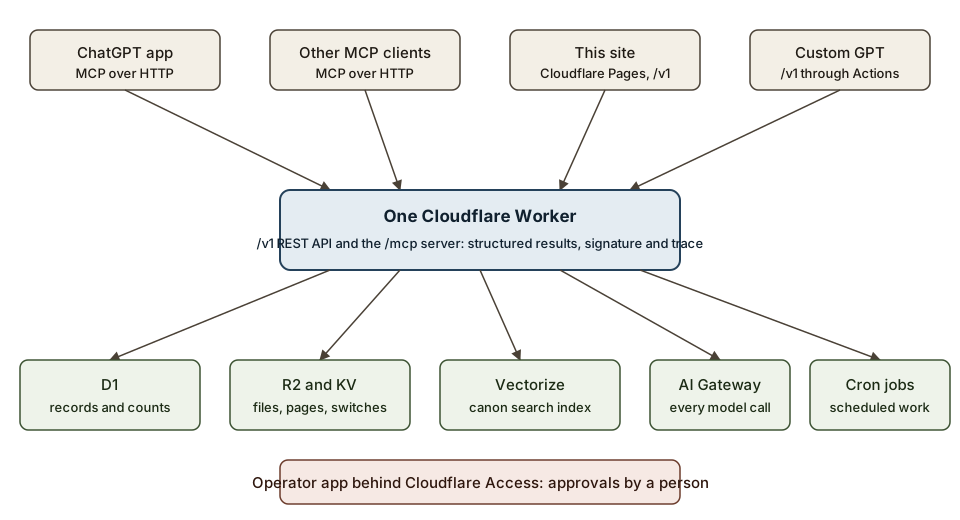
- Clients. The ChatGPT app and any other MCP client connect to the MCP server. This site and the custom GPT call the
/v1API. The site is a set of static pages on Cloudflare Pages, and each tool page runs its tool through the same API. - One Worker. The API and the MCP server are one Cloudflare Worker. Every tool result carries the signature line and the trace line.
- Stores. D1 holds the records the data model names, such as verified contacts with their consent, jobs, the nonprofit and professional directory, change notes and the weekly counts of the public ledger. R2 holds files and the published pages; KV holds the tool switches and the rate limits; Vectorize holds the search index over the canon's passages.
- Models. Every model call goes through Cloudflare AI Gateway.
- Scheduled jobs. Canon ingestion, reminders, the directory update and the weekly count for the public ledger run on a schedule. Canon ingestion and reminders run only while an operator has switched them on.
- Operator app. A separate app behind Cloudflare Access, where a person approves each outreach batch before anything is sent.
Named reviewers
No law firm or CPA firm reviews the canon yet. When one does, this section names the firm, what it reviewed and the date. Until then, the founder named above verifies every rule page.
Legal checks
Automated checks stand in for a paid attorney and CPA review. They block or flag; none of them is a legal opinion, and nothing on this site is legal or tax advice.
The rule check
Every outreach draft, reminder, message template, page draft and calculator memo is checked against a fixed list of rules before an operator approves it or it publishes, in its own language. Patterns for numbers and required lines run on every item; at the outreach and page approvals an AI model also reads each draft for the rules a pattern cannot catch. A failure blocks the item and the operator queue names the rule.
- No advice language.
- No identification, decree or account numbers.
- AI disclosure present.
- Opt-out present.
- No claim of government affiliation.
- No guaranteed tax outcome.
- Written in the item's language.
Watch, complaints and the calculator
- Legal watch: each new version of an official text, and later each weekly crawl, is checked for bills amending Act 60, DDEC and Hacienda circulars, court decisions and channel policy changes. A signal alerts the team with the clauses touched and the pages and tools behind them; nothing changes automatically.
- Complaint triggers: an opt-out rate above 2% of a batch, any spam report, any nonprofit asking to stop, or a reply mentioning an attorney, a demand or a cease request pauses the campaign and alerts the team within 5 minutes.
- Calculator cross-check: an AI second pass re-derives each worked scenario of the calculator from the official texts, and any disagreement with the hand-built spreadsheet blocks a calculator change until a founder resolves it.
Document checklist
The terms of service, the privacy policy, the disclosures and the outreach authorization language are checked against CAN-SPAM, TCPA and 10DLC consent rules, Meta's WhatsApp Business policy, Telegram's bot terms, OpenAI's app policies and, from Phase 2, Google's API user data policy.
Result of the last run: 20 checks pass, 3 fail and 1 apply from Phase 2.
| Framework | Requirement | Document | Result |
|---|---|---|---|
| Legal rule list | Passes every rule of the legal rule list in both languages. | Terms of service | Pass |
| Legal rule list | Passes every rule of the legal rule list in both languages. | Privacy policy | Pass |
| Legal rule list | Passes every rule of the legal rule list in both languages. | Disclosures | Pass |
| Legal rule list | Passes every rule of the legal rule list in both languages. | Outreach authorization | Pass |
| CAN-SPAM | Names the sender. | Disclosures | Pass |
| CAN-SPAM | Every email carries a working unsubscribe link. | Message code | Pass |
| CAN-SPAM | Every email carries the sender's valid postal address. | Message code | Fail |
| CAN-SPAM | Outreach discloses AI drafting in its first paragraph. | Message code | Pass |
| CAN-SPAM | The authorization names the recipients, the AI disclosure, the human approval and how to stop. | Outreach authorization | Pass |
| TCPA and 10DLC consent | The SMS consent line states frequency, rates, STOP and HELP. | Disclosures | Pass |
| TCPA and 10DLC consent | Texts carry no marketing content. | Disclosures | Pass |
| TCPA and 10DLC consent | STOP, UNSUBSCRIBE, CANCEL, QUIT and END end SMS to that number. | Message code | Pass |
| TCPA and 10DLC consent | An SMS reply of HELP gets the help message. | Message code | Fail |
| Meta's WhatsApp Business policy | The person writes first or opts in; only utility templates go out otherwise. | Disclosures | Pass |
| Meta's WhatsApp Business policy | Only utility templates exist (reminder, job update, verification); none is marketing. | Message code | Pass |
| Meta's WhatsApp Business policy | STOP in WhatsApp ends messages. | Message code | Pass |
| Telegram's bot terms | Says the bot runs in privacy mode and how to stop it. | Disclosures | Pass |
| Telegram's bot terms | The bot answers /stop and sends nothing more. | Message code | Pass |
| OpenAI's app policies | The privacy policy says what the ChatGPT app sends and keeps. | Privacy policy | Pass |
| OpenAI's app policies | The terms say the service is not legal or tax advice and files nothing. | Terms of service | Pass |
| OpenAI's app policies | The privacy policy says no identification, decree or account numbers are asked for. | Privacy policy | Pass |
| OpenAI's app policies | The privacy policy explains how to have data deleted. | Privacy policy | Pass |
| TCPA and 10DLC consent | The privacy policy names what is kept for SMS, Telegram and WhatsApp contacts. | Privacy policy | Fail |
| Google's API user data policy (Phase 2) | The privacy policy states Google's Limited Use terms for Calendar data. | Privacy policy | From Phase 2 |
This checklist is an automated check, not a legal opinion. A failing item stays listed here until it is fixed. No attorney has reviewed these documents.